Hair thinning can affect more than your appearance. It may change how you style your hair, how comfortable you feel in photographs, and how confident you feel in everyday life. At Modern Pain Management & Regenerative Institute, hair restoration begins with a thoughtful medical evaluation, not a standard treatment package. Our nonsurgical protocol combines platelet-rich plasma, or PRP, with absorbable PDO threads placed in targeted areas of the scalp. PRP is prepared from a small sample of your own blood and provides a concentrated source of platelets and signaling proteins involved in the body’s natural repair response. PDO threads are intended to create an additional localized stimulus within the scalp as the absorbable material gradually dissolves.
Together, these treatments are used to support existing hair follicles and improve the appearance of hair density in appropriate candidates. Every injection and thread placement is performed by a physician, with treatment planned around your pattern of hair loss, scalp health, medical history, and personal goals. PRP and PDO threads do not create new hair follicles, and results vary. Treatment is generally better suited to areas of thinning where active follicles remain than to areas of longstanding, complete hair loss.
Discover a More Thoughtful Approach to Hair Restoration
PRP hair restoration is an in-office procedure that uses platelet-rich plasma prepared from a small sample of your own blood.
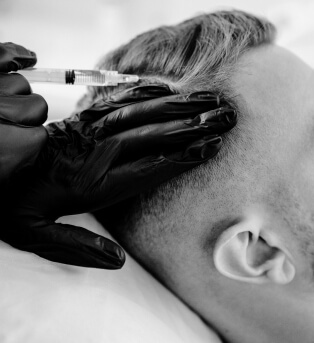
Your blood is placed into a centrifuge, which separates and concentrates a platelet-rich portion of the plasma. The prepared PRP is then carefully injected into selected areas of the scalp by one of our physician injectors.
Platelets contain growth factors and signaling proteins involved in the body’s natural repair response. When PRP is introduced into the scalp, it may help support follicle activity and improve hair density in some patients experiencing pattern hair loss.
Research suggests that PRP may improve hair density in patients with androgenetic alopecia, also known as male or female pattern hair loss. However, PRP preparation methods, treatment schedules, and individual responses vary. It should not be presented as a guaranteed cure for hair loss.
Learn more about the role of PRP in our Regenerative Medicine services.
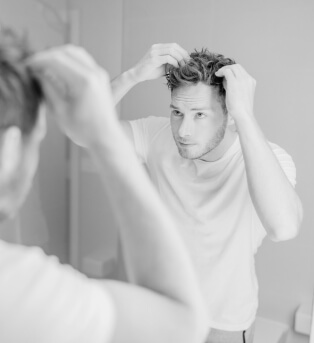
Your visit begins with a conversation about when your hair loss started, how it has progressed, previous treatments, relevant medical conditions, medications, and your goals. Your physician will examine the areas of concern and determine whether the pattern appears appropriate for the Modern Pain Management hair restoration protocol.
A small sample of blood is collected and processed in a centrifuge. This separates the platelet-rich portion that will be used during your treatment.
The scalp is cleansed and may be numbed to help improve comfort. Your physician then places the PRP into targeted areas based on your pattern of thinning.
Fine absorbable PDO threads are placed beneath the skin in selected areas of the scalp. The exact number and placement will depend on your treatment plan.
PDO, or polydioxanone, is an absorbable material that has been used in medical sutures for many years. During scalp threading, fine PDO monofilaments are placed beneath the skin in targeted areas of thinning hair.
The threads remain temporarily within the scalp before gradually dissolving. Their placement is intended to create a sustained local tissue response that may complement the more immediate biologic signals provided by PRP.
Early clinical studies have reported improvements in hair count among some patients treated with scalp threads. However, PDO threading for hair restoration remains an emerging treatment, and the available research is more limited than the evidence supporting established hair-loss medications or PRP.
At Modern Pain Management, PDO threads are used thoughtfully as part of our combined protocol. Your physician will explain the role of each treatment, the limitations of the available evidence, and what results may be realistic for you.

PRP hair restoration may be considered for men and women who:
The cause of hair loss matters. PRP may not be appropriate for every form of thinning or shedding.
Sudden hair loss, completely bald patches, scalp pain, significant itching, redness, scaling, scarring, or rapid shedding may indicate a condition that requires additional medical or dermatologic evaluation. Hair loss associated with medications, illness, nutritional deficiencies, hormonal changes, or autoimmune conditions may also require a different or more comprehensive approach.
If your symptoms suggest that another evaluation should come first, we will explain that honestly.
Hair restoration should be guided by more than a trend or a standard package.
Modern Pain Management combines regenerative treatment options with experienced, physician-performed procedural care. Dr. Mariam El-Baghdadi brings more than 15 years of medical experience and has performed thousands of injections throughout her career.
Patients choose Modern Pain Management for:
Hair restoration is part of our broader Aesthetics and Longevity services, designed for patients seeking thoughtful treatments that support confidence and natural-looking results.
Bridget W.
PRP and PDO threads are intended to provide different types of stimulation within the treated scalp. PRP delivers a concentrated preparation of platelets and signaling proteins at the time of treatment. PDO threads remain temporarily beneath the skin, where they are intended to create a longer-lasting local tissue response as they dissolve. The evidence supporting PDO threads for hair loss is still emerging. We use them as an adjunct within a physician-guided protocol, not as a guaranteed solution.
Hair restoration is a gradual process. PRP and PDO thread treatments do not produce immediate changes in hair length or density.
Because hair grows in cycles, it may take several months before changes become noticeable. Some patients may notice less shedding or an improvement in the appearance of density before they see more visible changes in hair coverage.
A series of treatments may be recommended, followed by periodic maintenance. The number and timing of your visits will be based on your degree of thinning, response to treatment, and long-term goals.
Results vary. Some patients experience meaningful improvement, while others may see limited change.
PRP hair restoration involves more than drawing blood and placing injections throughout the scalp.
The pattern, depth, and location of each injection should reflect the patient’s anatomy and areas of active thinning. Medical history, medications, scalp conditions, bleeding risk, and the underlying pattern of hair loss also need to be considered.
At Modern Pain Management & Regenerative Institute, PRP injections and PDO thread placement are performed by physician injectors with extensive procedural experience. You will never be moved through a one-size-fits-all hair restoration protocol.
Research suggests that PRP may help improve hair density in some men and women with androgenetic alopecia, commonly known as pattern hair loss. Results vary considerably. PRP may be more helpful when treatment begins while active follicles remain, and it may not restore hair in areas of longstanding complete baldness.
PRP injections and PDO scalp threading are not FDA-approved specifically for treating hair loss. Devices used to prepare PRP and PDO materials may have FDA clearances for other medical purposes, but those clearances should not be interpreted as FDA approval of the hair restoration treatment itself. Your physician will explain the treatment’s regulatory status, available evidence, potential benefits, limitations, and risks before you decide whether to proceed.
Yes. PRP hair restoration may be considered for both men and women experiencing certain types of thinning hair.
The pattern and possible cause of hair loss may differ between men and women, so every patient should be evaluated individually before treatment is recommended.
There is no universal treatment schedule. A series of initial treatments may be recommended, followed by maintenance visits to help support results.
Your physician will recommend a schedule based on your pattern of thinning, response to treatment, and goals.
Most patients can return to many normal activities relatively quickly, but the scalp may feel tender or sensitive following treatment.
Temporary redness, swelling, bruising, itching, or pinpoint bleeding can occur. You will receive specific aftercare instructions before leaving the office.
PRP and PDO thread treatments do not permanently stop genetic or age-related hair loss.
Hair thinning can continue over time, and maintenance treatments or other medical therapies may be recommended. Your physician will discuss a long-term plan based on your response and the likely cause of your hair loss.
You will receive instructions about washing your hair, using hair products, exercising, sun exposure, and caring for the scalp following treatment.
Temporary tenderness, redness, swelling, bruising, itching, or pinpoint bleeding may occur around treated areas. Your physician will explain what is expected and when you should contact the office.
Discover a Personalized Approach to Hair Restoration
You do not have to choose between an impersonal hair clinic and an overly simplified treatment package. At Modern Pain Management, hair restoration is performed by physicians and personalized around you. Our PRP and PDO thread protocol offers a thoughtful nonsurgical option for eligible men and women experiencing thinning hair. Schedule a consultation at our Libertyville practice to learn whether physician-performed hair restoration may be appropriate for you.